
Adoption in Lebanon is available to both Lebanese nationals and foreign nationals. Every Lebanese adoption, regardless of which route applies, requires civil enforcement and registration before the adopted child can obtain a passport.
Which court hears the case depends entirely on the adopter’s personal law. A Lebanese national belonging to a recognised community goes to the spiritual court of that community. A foreign national goes to the Lebanese civil courts, which apply the adopter’s own national law — not Lebanese law. Lebanon is not a party to the Hague Convention of 29 May 1993, so nothing is recognised automatically in either direction.
This guide details the adoption process and laws in Lebanon.

In This Article
Which Court Hears an Adoption in Lebanon?
Lebanon has no civil adoption statute of its own. It does not follow that adoption is unavailable. It follows that the forum, and the law applied in it, are set by the adopter’s personal law.
Two provisions carry the structure.
- Article 31 of the Law of 2 April 1951 confines the confessional courts to applying their confessional laws to their own members and to no one else.
- Article 10 of Decision No. 60/L.R. of 13 March 1926, as amended by Legislative Decree No. 146 of 1938, subjects foreigners in personal status matters to their national law, even where they belong to a recognised community.
Read together, they produce a clean allocation.
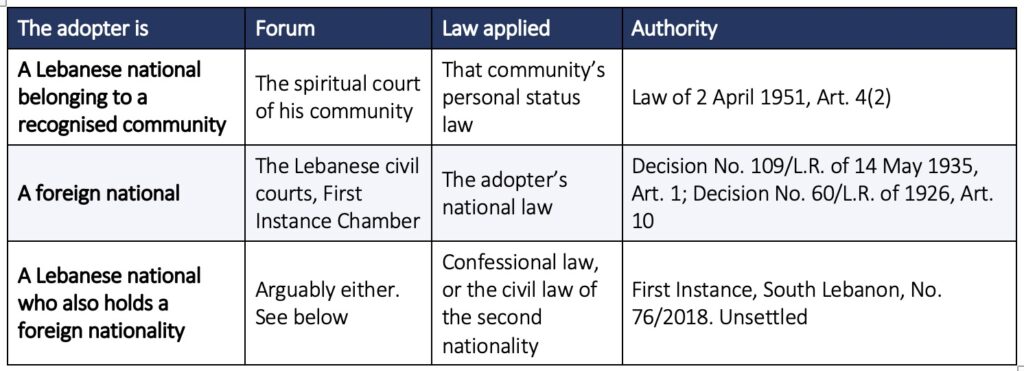
The civil courts are the courts of general jurisdiction; the confessional courts are exceptional (Code of Civil Procedure, Art. 84). Where no confessional court is competent over an adopter, the civil courts are not a fallback. They are the ordinary forum.
How does a Lebanese national adopt?
Whether a Lebanese national can adopt at all depends on his community. The Christian communities recognise adoption. The Muslim communities do not.
A Lebanese Christian applies to the spiritual court of his community, where Article 4(2) of the Law of 2 April 1951 places adoption.
A Lebanese Muslim has no equivalent route: the Sunni and Ja’fari courts do not hear adoption applications, and the institution available to him is kafala, which is the assumption of a child’s custody, maintenance and care. Kafala creates no filiation and does not transmit the guardian’s family name.
The general rules
Each Christian community has its own personal status code, and the conditions are not uniform.
Five features recur across them:
- The adoption must be justified. The petition states the reason for it, and the court satisfies itself of the adopter’s good conduct before allowing it.
- An age gap is required between adopter and adoptee. Eighteen years is the usual figure.
- Consents must be gathered: of the adoptee where he is old enough to hold a view, of his parents or guardian, and, where the adopter is married, of his spouse.
- Adopter and adoptee are expected to share the same religion.
- The adoption takes effect by a judgment of the spiritual court, ratified by the competent religious superior. Neither element alone suffices.
Beyond that common core the codes diverge, and the divergence is substantive.
Two examples make the point:
Example: the Catholic communities
Article 100 of the Personal Status Law of the Catholic Communities provides:
المادة 100- كل شخص علماني، رجلا كان او امرأة، تجاوز الاربعين من عمره يستطيع ان يتبنى بشرط ان لا يكون له نسل شرعي وقت التبني، وان يزيد عمره ثماني عشرة سنة عمن يريد ان يتبناه، وذلك تحت طائلة البطلان.
Article 100. Any lay person, man or woman, who has passed forty years of age may adopt, on condition that he has no legitimate filiation at the time of the adoption, and that he is eighteen years older than the person he wishes to adopt, this on pain of nullity.
The article sets three conditions, each sanctioned by nullity: the adopter must be over forty, must have no legitimate filiation at the time of the adoption, and must be eighteen years older than the adoptee.
Adoption by a single person is possible under this code. Article 100 speaks of any lay person, man or woman, and it is Article 102 that treats adoption by two people as the exception, permitted only where they are spouses. A married person may also adopt alone, with the consent of the other spouse (Article 103).
A couple who already have a legitimate filiation are not accommodated here, since the condition is sanctioned by nullity and the code provides no dispensation from it. That does not close off adoption in Lebanon to them. It moves the question elsewhere: to a community whose code imposes no such condition, or, where the adopter is a foreign national, to the civil route, in which the Lebanese conditions do not apply at all.
The code adds that a Catholic’s adoptee must be Catholic, though not necessarily of the same rite (Article 101), and that the adoption is valid only by a decision of the ecclesiastical court ratified by the eparchial bishop (Article 112).
Example: the Syriac Orthodox
The Syriac Orthodox code, ratified by Patriarch Ignatius Zakka I Iwas on 10 September 2003, is lighter.
Article 73 requires only that the adopter be eighteen years older than the adoptee, that the adoptee consent or his guardians consent for him, and that a petition stating the reason for the adoption be put to the ecclesiastical presidency, on which the ecclesiastical court then rules. There is no minimum age for the adopter and no condition touching his existing filiation.
The two codes also differ in what an adoption produces. Under Article 98 of the Catholic law it creates civil filiation: legitimate paternity and sonship, carrying the adopter’s family name and rights in his estate. Under Article 75 of the Syriac Orthodox code it creates putative kinship, قرابة وضعية, under which the child becomes a son by position, owed maintenance and care and owing obedience in return.
The community therefore determines not only which court the adopter goes to, but what he holds at the end of it.
How does a foreign national adopt a Lebanese child?
To adopt a child in Lebanon, foreign national applies to the Lebanese civil courts, and the court applies the adopter’s national law. There is no requirement that the adopter reside in Lebanon.
Article 1 of Decision No. 109/L.R. of 14 May 1935 gives the Lebanese civil courts exclusive jurisdiction over personal status actions concerning one or more foreigners where at least one of them belongs to a country in which personal status is governed by civil law. Article 74 of the Code of Civil Procedure subjects international jurisdiction to the internal rules, without distinction between Lebanese and foreigner.
In Decision No. 76/2018 of 11 December 2018, the First Instance Chamber in South Lebanon applied this framework to grant the adoption of a Lebanese foundling girl by a couple resident in Saida. The confessional courts had no jurisdiction, because under Article 31 of the Law of 2 April 1951 they apply their confessional laws only to their own members, and because the spouses were of different confessions. The Chamber therefore applied the Civil Code of Quebec.
That leaves the two questions on which a foreign file is actually won or lost. What is the foreign law, and does the applicant meet it?
Proving the content of the foreign law
Foreign law is applied in Lebanon as law, not as fact. It is applied by force of the Lebanese conflict rule, and it does not lose its legal character because it is foreign. The judge may call on the parties to establish its content, and in practice he does. What follows is that the burden of putting the foreign law before the court sits with the applicant, even though the court is not treating it as evidence.
Because the law is foreign, it receives distinct procedural treatment. Decision No. 76/2018 shows what that means in a real file.
The Chamber ordered the applicants to produce three things:
- A certified copy of the foreign text, and not the whole code: the Chamber specified Articles 564 and 565 of the Civil Code of Quebec, the provisions that actually governed the application.
- A statement from the competent authority in that jurisdiction confirming that the text produced is the version currently in force and has not been amended. A certified copy of a superseded provision proves nothing.
- A legal opinion, authenticated by the foreign ministries of both states, addressing a specific question the Chamber had identified: whether Quebec law prevents a parent who already has children from adopting. The applicants produced it, and it confirmed that no such bar exists.
The third requirement is the one foreign counsel tend not to anticipate. The court did not ask for a general opinion on Quebec adoption law. It framed a question, because the condition in the Catholic code touching the adopter’s existing filiation has no obvious counterpart abroad and the Chamber wanted the point closed. A file that arrives with a certified statute and no opinion on the points the court cares about will be sent back for the opinion.
Satisfying the conditions of the foreign law
Once the content of the foreign law is established, the court applies its conditions to the applicant. It does not apply Lebanese conditions.
In Decision No. 76/2018, the conditions drawn from the Quebec text and tested against the applicants included that the adopters be spouses sharing conjugal life, that the adopter be at least eighteen years older than the adoptee, and that the adopter or one of the spouses profess the same religion as the adoptee. The Chamber found that most of the conditions imposed were satisfied in the applicants’ case.
Two further filters operate alongside the foreign conditions.
The first is Lebanese public order. The Chamber examined whether the foreign conception of adoption was broadly consistent with the Lebanese one, that is, with adoption as a ceremonial judicial contract creating between two persons the civil bonds of legitimate paternity and sonship, and with the interest of the adoptee. It found the Quebec provisions generally compatible. Where a foreign law offered something materially different, that examination is where the difficulty would arise.
The second is the court’s own assessment of the child’s interest, which is not delegated to the foreign law at all. The Chamber appointed a social expert, who reported that the economic, social and health circumstances in which the child was living were good and that the applicants’ social and moral position suited their application. The Chamber also heard the applicants and had them bring the child to the courtroom on several occasions before satisfying itself. The adoption was then granted with full legal effects and ordered registered in the Lebanese Personal Status register.
One point of sequence is worth noting for the receiving state. Article 565 of the Civil Code of Quebec provides that the adoption of a child domiciled outside Quebec is granted either abroad or by a judicial decision rendered in Quebec, and that a decision rendered abroad is subject to recognition by the Quebec court unless the competent authority of the state in which it was made certifies that it conforms to the Convention on Protection of Children. Lebanon is not a party to that Convention, so the certificate is unavailable and the recognition step is not. Foreign advisers should read their own law for the equivalent provision before the Lebanese file is opened, rather than after the judgment is in hand.
Can a Lebanese national with a second nationality choose?
This is the most consequential question in the field, and it is unsettled.
The case for choice rests on Decision No. 76/2018. The adopters were a Lebanese man holding Canadian nationality and his Algerian wife holding Canadian nationality. The Chamber treated the Canadian nationality as the operative connecting factor, took civil jurisdiction and applied Quebec law. On its face, that is a Lebanese national adopting in Lebanon under the civil law of his second nationality.
A second route points the same way. In Decision No. 34/2007 of 8 February 2007, the First Instance Court of Mount Lebanon held that where the adopter had married the child’s mother civilly in Nicosia, the adoption branched from that civil marriage, so Article 79 of the Code of Civil Procedure conferred jurisdiction on the civil court and Cypriot law applied.
Three reasons for caution should be stated plainly.
- Both decisions are first instance. Neither binds any other court, and no Court of Cassation authority endorses them.
- Neither addresses the orthodox rule that where a person holds Lebanese nationality alongside a foreign nationality, the Lebanese nationality prevails before Lebanese authorities. The point was not argued and was not decided.
- In both cases the spouses were of different confessions, or one spouse was a foreign national, so no single confessional court was competent over the couple. Where a competent confessional forum exists and simply declines the application, the reasoning may not carry across.
The risk arises where a dual national relies on the second nationality although a confessional forum would otherwise be competent over him. Practitioners commonly encounter the question at enforcement rather than at judgment, since the head of the Execution Department must satisfy himself that the decision emanated from a competent authority.
Can a Muslim adopt in Lebanon?
The Sunni and Ja’fari courts do not hear adoption applications. A Lebanese Muslim who has only Lebanese nationality therefore has no route to adoption in Lebanon. The available institution is kafala, which is the assumption of a child’s custody, maintenance and care. Kafala creates no filiation and does not transmit the guardian’s family name.
The position is different for a Muslim who is a foreign national. Because the civil courts apply the adopter’s national law and not any Lebanese confessional law, a Muslim who is a national of a state whose law provides for adoption falls within the ordinary civil route described above. His religion is not the operative fact. His personal law is.
Where the adopter is a Muslim holding both Lebanese and foreign nationality, the position is unsettled for the reasons given in the preceding section. Decision No. 76/2018 supports the argument, but it is a first instance decision, the dominant nationality objection was never argued in it, and its facts included a foreign spouse of a different confession. The law here is not settled, and it should not be presented as though it were.
What are the four steps in adoption?
- Identifying a child. Children available for adoption are generally in licensed institutions supervised by the Ministry of Social Affairs. The juvenile judge, sitting under Law No. 422 of 6 June 2002, may place a child with a family provisionally, but that placement is not an adoption and confers no filiation. Many adoptees are foundlings, who are Lebanese by operation of law.
- Applying. A Lebanese national petitions the spiritual court of his community, in principle that of his domicile or of the minor’s domicile (Catholic law, Art. 113). A foreign national files before the First Instance Chamber and must be ready to prove the content of his national law. In both forums the court investigates capacity, hears the officer representing the public interest, and takes the consents the applicable law requires.
- Obtaining the judgment. A confessional judgment is not valid until ratified by the competent religious superior. Under Article 112 of the Catholic law no adoption is valid without a decision of the ecclesiastical court ratified by the eparchial bishop. A civil judgment needs no ratification.
- Enforcing it. A confessional judgment goes to the Execution Department of the civil court for executory force, the exequatur. The Ministry of Interior and Municipalities then issues an administrative decision accepting the adoption, and the Personal Status registers amend the child’s entry. General Security issues the passport last, on the strength of those documents.
Enforcement is where files stall, on two points.
First, the Execution Department may not decline the file for want of jurisdiction. In Decision No. 67/2015 of 1 December 2015, the Full Bench of the Court of Cassation set aside a refusal by a head of Execution who had held that amendment of the civil registers belonged to the single judge. He was required to retain jurisdiction and to examine whether the decision was capable of execution and consistent with public order, in light of the nationality of the adopted child.
Second, General Security publishes the passport requirements. The published file calls for:
- An investigation report by the Internal Security Forces
- A birth certificate conforming to current regulations, and a civil status extract bearing the child’s adoptive name
- The orphanage’s waiver document, and the orphanage’s accreditation
- The adoption decision of the spiritual court
- The adoptive family’s marriage attestation, and a certified copy of their passport
- Judicial record extracts for the child and for the adoptive parents
- A medical attestation of the infertility of one of the spouses
- Baptism attestations for the child and the adoptive parents
- The approval of the local governmental entities, and of the Ministry of Interior and the municipality
- An attestation that neither the parents nor the orphanage received any payment
- A proxy from one parent to the other if one cannot attend
Documents must be authentic and copies certified. The file is opened at the General Secretariat of General Security by the adoptive parents in person, then transferred to the Bureau of Passports, Naturalisation and Foreign Affairs.
The infertility and baptism attestations are administrative requirements; neither is imposed by the adoption articles of the Catholic code. The no-payment attestation is an anti-trafficking control.
What are the effects of an adoption in Lebanon?
The effects follow the code the court applied.
Under the Catholic code, the adoptee takes the adopter’s family name and acquires towards him the rights and duties of a legitimate child (Article 106), and impediments to marriage arise between the adopter, the adoptee and his descendants, the adopter’s later children, and children adopted by the same person (Article 111).
One effect regularly surprises foreign advisers: the tie to the birth family is not severed. Article 107 provides that the adoptee remains a member of his original family, with all rights and duties in it, parental authority alone passing to the adopter. Confessional adoption in Lebanon is therefore closer to the French adoption simple than to a full adoption.
What does an adopted child inherit in Lebanon?
Succession of non-Muslims in Lebanon is governed by the Inheritance Law for Non-Muhammadans of 23 June 1959, a civil statute. Article 23 provides that the adopted child is deemed a legitimate child in everything concerning his rights in the estate of the one who adopted him or in his will.
The Court of Cassation has applied it. In Decision No. 56/2011 of 21 June 2011, the Fourth Chamber held that a duly adopted daughter enjoyed by law the same rights as a legitimate child.
An adopted child therefore takes in the adopter’s estate as a legitimate child takes.
Does adoption confer Lebanese nationality?
The answer turns on where the adoption takes place, and on the child’s own position at birth. It does not turn on the adoption itself.
A Lebanese child adopted in Lebanon
He is Lebanese, and he was Lebanese before the adoption. Article 1 of Decision No. 15/S of 19 January 1925 provides:
المادة 1- يعد لبنانياً:
1- كل شخص مولود من أب لبناني.
2- كل شخص مولود في أراضي لبنان الكبير ولم يثبت أنه اكتسب بالبنوة عند الولادة تابعية أجنبية.
3- كل شخص يولد في أراضي لبنان الكبير من والدين مجهولين أو والدين مجهولي التابعية.
Article 1. The following are deemed Lebanese:
(1) any person born of a Lebanese father;
(2) any person born on the territory of Greater Lebanon who is not proved to have acquired a foreign nationality by filiation at birth;
(3) any person born on the territory of Greater Lebanon of unknown parents, or of parents of unknown nationality.
A child placed for adoption in Lebanon is ordinarily a foundling. The licensed association that takes him in issues a birth document and registers him as a foundling under Article 16 of the Law of 7 December 1951 on the registration of personal status documents, and he holds Lebanese nationality from birth under paragraph 3.
What the adoption does is move him from the entry opened in the association’s name to his new family’s entry in the Personal Status registers. The President of the Cases Authority at the Ministry of Justice, Judge Helena Iskandar, has put the position publicly: adoption cannot grant Lebanese nationality to adopted children, because they already hold it before the adoption.
A child who is not Lebanese
Where the child does not answer Article 1, the position is more difficult, and it has not been settled.
The concern the courts have expressed is not with adoption but with the registration mechanisms around it.
In Decision No. 205/2013 of 17 December 2013, the Single Civil Judge in Jib Jannine required DNA testing to support acknowledgement of an illegitimate child under Article 15 of the Law of 7 December 1951, expressly to stop that mechanism being used to effect unlawful adoptions of non-Lebanese children and to obtain Lebanese nationality contrary to law.
That decision should not be read as settling anything. It is a decision of a single judge. It binds no other court, no Court of Cassation authority has endorsed it, and it concerns the acknowledgement of filiation rather than adoption. What it shows is the concern the judiciary has about the boundary, not the rule that will be applied at it. The position of a child who is not Lebanese remains debatable.
An adoption effected outside Lebanon
Here too the position is open, and it should not be stated as though it were settled.
Article 1 attaches nationality to birth: birth to a Lebanese father, or birth on Lebanese territory. A child adopted abroad by Lebanese parents answers neither description.
Article 2 gives Lebanese nationality to an illegitimate child whose filiation is established while he is a minor, where the parent in respect of whom filiation is first established is Lebanese. Whether an adoption judgment amounts to the establishment of بنوة for the purposes of Article 2 has not been decided.
The argument that it does draws on Article 98 of the Catholic code, under which adoption creates the civil bonds of legitimate paternity and sonship. The argument that it does not is that Article 2 addresses the establishment of natural filiation, not its judicial creation.
The adoption itself is a separate question from nationality, and it is the easier one. Article 118 of the Catholic code provides:
المادة 118- التبني الذي يجري في بلاد ليس فيها للمحاكم الكنسية اختصاص في هذه المادة يحكم على صحته او بطلانه وفقا لقوانين تلك البلاد.
Article 118. An adoption effected in a country in which the ecclesiastical courts have no jurisdiction in this matter is judged valid or void according to the laws of that country.
So an adoption made abroad may well be valid, and may be given effect in Lebanon on exequatur. That the adoption is recognised does not answer whether the child takes Lebanese nationality. The two questions are distinct, and the second has no clear answer in the texts.
Will the adoption be recognised in the adopters’ country?
This question concerns foreign parents who have adopted a Lebanese child.
Their judgment comes from a Lebanese civil court which applied their own national law, and that is the feature that should make recognition straightforward at home. The court has already measured them against the conditions their own legislature set. A foreign authority asked to give effect to the judgment is not being asked to accept a foreign institution of adoption, but its own.
Recognition nonetheless remains a question for that state’s law, and one feature of the Lebanese position bears on it. Lebanon is not a party to the Hague Convention of 29 May 1993 on Protection of Children and Co-operation in Respect of Intercountry Adoption. No central authority mechanism operates between Lebanon and any other state, and nothing is recognised automatically.
Some states restrict or refuse adoptions from countries outside the Convention; others require their own court to recognise the decision before it has effect. That question belongs in the adopters’ jurisdiction, and it is better answered before the Lebanese file is opened than after the judgment is in hand.
Lebanon takes the same view of judgments coming the other way. In Decision No. 94/2007 of 28 June 2007, the Fifth Chamber of the Court of Cassation refused to let an adopter rely on a foreign judgment concerning his adopted son, because it had not been clothed with the executory force Article 1012(2) of the Code of Civil Procedure requires. Recognition is automatic in neither direction.
The passport and the nationality are separate questions
The child will hold a Lebanese passport. He is Lebanese, ordinarily as a foundling born on Lebanese territory, and the adoption moves his entry to the adopters’ names in the Personal Status registers. General Security then issues the passport against the adoption decision, the Ministry of Interior’s approval and the amended registration. That is what allows the family to leave Lebanon lawfully, and it is the end of what Lebanon determines.
Whether the child also acquires the adopters’ nationality is not a Lebanese question. It is answered by the law of the adopters’ own country, and it does not follow from the Lebanese judgment.
Summary of Key Points
- The adopter’s personal law determines the forum. Lebanese nationals go to the spiritual court of their community. Foreign nationals go to the civil courts, which apply the adopter’s national law.
- Article 31 of the Law of 2 April 1951 confines confessional courts to their own members. Article 10 of Decision No. 60/L.R. of 1926 subjects foreigners to their national law in personal status.
- Whether a Lebanese dual national may elect the civil route is unsettled. Decision No. 76/2018 supports it; it is first instance and the dominant nationality objection was never argued.
- Under Article 23 of the Inheritance Law for Non-Muhammadans of 23 June 1959, the adopted child nonetheless takes in the adopter’s estate as a legitimate child.
- A child adopted in Lebanon is ordinarily Lebanese already, as a foundling born on Lebanese territory, so nothing needs to be conferred. Where the child is not Lebanese, or the adoption is effected abroad, the position is unsettled.
- Lebanon is not a party to the Hague Convention of 29 May 1993, so nothing is recognised automatically in either direction.
Frequently Asked Questions
Can foreigners adopt a child from Lebanon?
Yes, foreigners can adopt a child from Lebanon and residence in Lebanon is NOT required. A foreign national applies to the Lebanese civil courts, which take jurisdiction under Article 1 of Decision No. 109/L.R. of 14 May 1935 and apply the adopter’s own national law. The applicant must prove the content of that law by a certified copy and, where the court requires it, an authenticated legal opinion.
Can Muslims adopt in Lebanon?
A Lebanese Muslim holding only Lebanese nationality cannot adopt in Lebanon. The Sunni and Ja’fari courts do not hear adoption applications, and the available institution is kafala, which creates no filiation.
A Muslim who is a foreign national falls under the civil route, because the civil courts apply his national law rather than any Lebanese confessional law.
Which court hears an adoption in Lebanon?
It depends on the adopter’s personal law. A Lebanese national belonging to a recognised community goes to that community’s spiritual court under Article 4(2) of the Law of 2 April 1951. A foreign national goes to the First Instance Chamber of the civil courts, which apply his national law.
Does an adopted child acquire Lebanese nationality?
The question does not usually arise. A child placed for adoption in Lebanon is ordinarily a foundling born on Lebanese territory, and is therefore Lebanese from birth under Article 1(3) of Decision No. 15/S of 19 January 1925, before any adoption. Where the child is not Lebanese, or where the adoption is effected abroad, the position is not settled and turns on provisions that were written for birth and filiation rather than adoption.
Is a Lebanese adoption recognised abroad?
That depends on the receiving state’s law. Lebanon is not a party to the Hague Convention of 29 May 1993, so no automatic recognition applies and some states restrict adoptions from non-Convention countries. Where a Lebanese civil court has applied the adopters’ own national law, the foreign authority is being asked to give effect to its own law, which is the feature that tends to assist.
How long does the adoption process take in Lebanon?
No statutory deadline governs either the confessional or the civil stage. The variables are the investigation the court orders, the production of foreign law where the civil route applies, the exequatur, registration with Personal Status, and the General Security passport file, which is opened by the adoptive parents in person.
Speak To Our Team About Your Adoption Case
Fakhry Law Firm advises Lebanese and foreign parents on adoption files in Lebanon, and works with foreign counsel acting for adopters abroad.
We advise on family law matters in Lebanon, the UAE, and across the region. Whether you are a Lebanese national navigating the confessional route, a foreign national adopting a Lebanese child, or a family dealing with cross-border recognition questions, our team has the expertise to guide you through each stage of the process.
Email info@fakhrylawfirm.com or contact us here to schedule a consultation.